 Greek
 English

Amaliada
67 Eptanisou & Karaiskaki
Programme leading to certification of Professional Knowledge and Skills by GLOBAL CERT, accredited by the Hellenic Accreditation System (ESYD) in accordance with the ISO/IEC 17024 standard
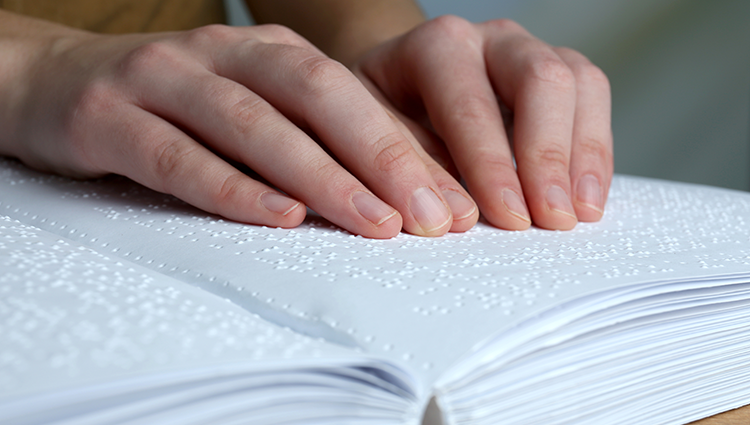
The KDBM EPIKENTRO VOCATIONAL TRAINING, a KDBM certified by the National Organisation for the Certification of Qualifications and Vocational Guidance (EOPPEP) and the Ministry of Education, Religious Affairs and Sports (certification code: 2000540), in cooperation with the University of West Attica, delivers the annual credit-bearing seminar "BRAILLE Writing and Reading System for the Blind".
The annual seminar lasts 7.5 months (350 hours) and is delivered entirely by distance learning through asynchronous education without mandatory attendance.
For information, click here.
Scoring Credits
With the Training Certificate, the trainee receives, under the legislation in force:
To submit an application, click the link: https://kedivim.uniwa.gr/apply/?course_name=systima-grafis-anagnosis-tyflon-braille
The training programme falls within the field of special education and concerns learning the language of the blind - the Braille writing and reading system. It focuses on studying the way people with total or partial visual disability write and read, as well as on a deeper understanding of the communicative, educational and social dimensions of the system.
Trainees will study historical information on the development of writing for the blind, the Greek and English Braille alphabets, as well as the special music and mathematics symbols. The programme is structured into a theoretical and a practical part, with an emphasis on practising writing and reading through applied exercises.
Developing training activities for learning the Braille system is particularly necessary both for professionals in education, social care and health, and for citizens who wish to contribute actively to inclusion and social accessibility, for the following main reasons:
Specifically, the programme aims at Comprehensive learning of Braille writing. A seminar on accessibility & social inclusion, for education, health & care professionals.
The training programme is aimed at professionals and citizens who wish to acquire specialised knowledge and skills in writing and reading the Braille system, with the aim of promoting the accessibility and inclusion of people with visual disabilities.
Specifically, the programme is aimed at:
The programme lasts 350 hours in total, is delivered over a period of 7.5 months and corresponds to 42 ECTS. Its cost is €380.00. A 10% discount is available for unemployed people and students.
Unit 1: Visual Disability and the Braille Code: Biography, Technology and Writing Methods
Unit 2: Blindness and Accessible Reading: Techniques and Learning the Greek Alphabet (Part A)
Unit 3: Blindness and Accessible Reading: Techniques and Learning the Greek Alphabet (Part A)
Unit 4: Tactile Communication and Printing: Touch Technologies, Braille and the English Alphabet
Unit 5: Grammatical and Symbolic Elements in the Braille Code: Punctuation, Accentuation and Special Symbols
Unit 6: Mathematics by Touch: Abraham Nemeth and the Language of Numbers in the Braille System
Unit 7: All Together with Equal Opportunities: Education (Ancient Greek), Accessibility and Autonomy for People with Visual Disabilities
Unit 8: Braille Music Notation: Reading and Learning for People with Visual Disabilities
Unit 9: Final Assessment
Professor
Department of Biomedical Sciences
Certified Trainer of the BRAILLE Language for the Blind
contact tel.: 2622024341
email: info@epikentroedu.gr
Reach us at any of our branch offices.
67 Eptanisou & Karaiskaki
Heroes’ Square (Plateia Iroon)
1 Dounia St